


If you've been researching how to upgrade your Challenger, Charger, 300, or Magnum with custom calipers, you've probably come across terms like "powder coating," "core exchange," and "curing." What do they all mean? This glossary breaks down everything you need to know about brake caliper refinishing in plain English.
The Basics: Components & Hardware
Brake Calipers
The metal housing that squeezes brake pads against your rotor to slow your vehicle. Calipers come in different sizes and styles depending on your vehicle model and brake package. For Mopar vehicles, common types include standard single-piston calipers, performance four-piston Brembo calipers, and factory SRT calipers.
Caliper Brackets
The mounting hardware that attaches the caliper to your vehicle's spindle or knuckle. Brackets can also be powder coated to match or complement your caliper color. Many customers choose to coat both calipers and brackets for a complete, finished look.
Pistons
The internal components inside the caliper that push the brake pads outward. During professional powder coating, pistons and all internal seals are removed before the coating process begins, then reinstalled with fresh components during reassembly.
The Process: Surface Preparation
Sandblasting (Media Blasting)
A surface preparation method where pressurized air propels abrasive material: typically sand or aluminum oxide: against the caliper surface. Sandblasting strips away old paint, rust, corrosion, and debris, exposing clean bare metal. This step creates the ideal surface texture for powder adhesion. After sandblasting, compressed air is forced through all internal passages to remove any remaining media particles.
Outgassing
The process of heating calipers in an oven before coating to release trapped moisture, oils, and gases from the metal. Calipers are typically heated to 440-450 degrees Fahrenheit for 30 minutes to 1.5 hours. Outgassing prevents bubbling, pinholing, and other defects that occur when trapped contaminants expand during the curing process.
Masking
The application of high-temperature tape and plugs to protect specific areas where powder should not adhere. Critical areas include piston bores, threaded bolt holes, mounting surfaces, and bleeder valve openings. Proper masking ensures the caliper functions correctly after coating and reassembles without complications.
Powder Coating vs. Paint: Understanding the Difference
Powder Coating
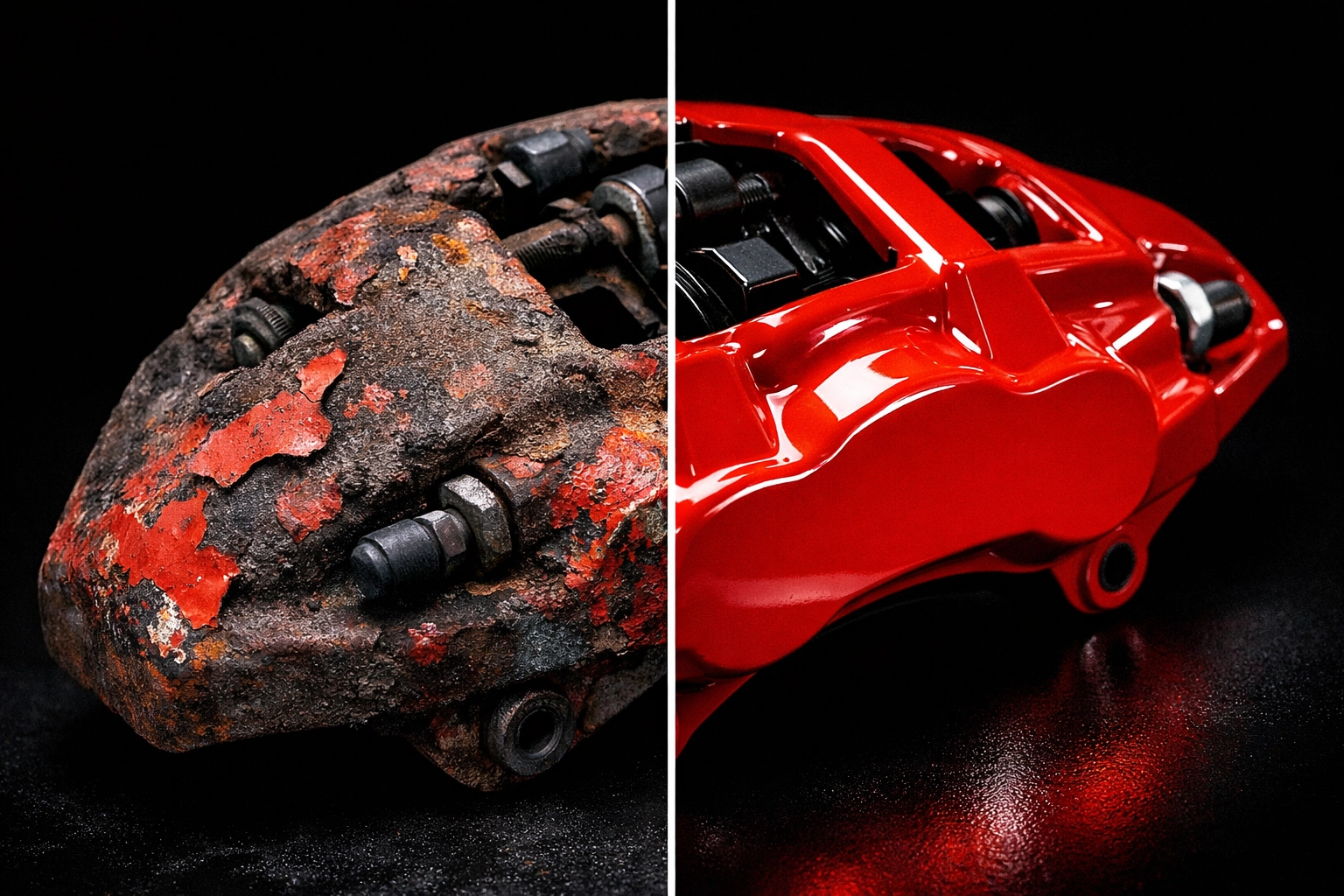
A finishing process where dry powder particles are electrostatically charged and sprayed onto metal parts, then heat-cured in an oven at approximately 400 degrees Fahrenheit. The heat causes the powder to melt, flow, and chemically bond to the metal surface, creating a uniform, durable finish. Powder coating is significantly more heat-resistant and durable than traditional paint.
Paint (Wet Coating)
Liquid coating that air-dries or bakes at lower temperatures. While paint can provide good aesthetics, it lacks the heat resistance and durability required for brake components. Paint tends to chip, fade, and discolor when exposed to the extreme temperatures generated by braking: often exceeding 500 degrees Fahrenheit during aggressive driving.
Curing
The oven-baking process that transforms powder coating from a dry powder into a hard, protective finish. During curing, the powder melts and undergoes a chemical reaction that bonds it permanently to the metal surface. Curing temperatures typically range from 375 to 400 degrees Fahrenheit, with cure times between 10 and 20 minutes depending on the coating system used.
Color & Finish Options
Factory Mopar Colors
OEM-matched powder coating colors that replicate the original brake caliper finishes found on Dodge, Chrysler, and SRT vehicles. Popular factory colors include TorRed, Go Mango, Plum Crazy, B5 Blue, and Sublime. Color-matching ensures your calipers blend seamlessly with your vehicle's overall aesthetic or provide a factory-correct restoration appearance.
Base Coat
The primary colored powder layer applied to the caliper. The base coat provides the main color but may appear slightly dull or flat until the clear coat is applied. Professional two-stage systems use specialized base coat powders designed to work with clear top coats for maximum depth and gloss.
Clear Coat (Top Coat)
A transparent powder layer applied over the base coat that enhances color depth, adds gloss, and provides additional protection against chips, chemicals, and UV exposure. Clear coating typically cures at 400 degrees Fahrenheit for approximately 10 minutes. Options include high-gloss clear for a wet-look finish or satin clear for a more subdued appearance.
Custom Decals
High-temperature decals applied as part of a two-stage finishing process, then protected under clear powder coat. After the base color is cured, a high-temp decal is applied and positioned, and then a powder coat clear is applied over the entire caliper (including over the decal) and cured. Encapsulating the decal under clear helps prevent fading from heat and UV exposure and helps ensure the decal never peels at the edges. This clear-over-decal step is a key part of a quality caliper refinishing process because the decal is protected like the rest of the finish.
Service & Customer Options
Core Exchange Program
A service option where customers purchase pre-finished calipers in their desired color, install them on their vehicle, then return their original calipers as a "core" for refurbishment. Core exchange significantly reduces turnaround time: customers receive finished calipers immediately rather than waiting for their original parts to be refinished. This program works similarly to purchasing remanufactured automotive parts with a core charge.
Turnaround Time
The duration from when calipers are received to when they are refinished, reassembled, and shipped back to the customer. Standard turnaround for caliper powder coating typically ranges from one to two weeks, depending on workload and complexity. Core exchange eliminates waiting time entirely, providing immediate availability.
Reassembly
The final stage where internal components: pistons, seals, O-rings, dust boots, and hardware: are reinstalled into the coated caliper. Professional reassembly uses fresh seals and components, with brake fluid serving as assembly lubricant for O-rings and internal parts. Proper reassembly ensures the caliper functions correctly and prevents leaks or binding issues.
Why These Terms Matter
Understanding brake refinishing terminology helps customers make informed decisions about their caliper customization project. Knowing the difference between powder coating and paint explains why one option costs more but lasts significantly longer. Recognizing what "core exchange" means clarifies why some customers choose this route for faster results.
Professional caliper refinishing involves more than simply spraying color onto parts. The process requires complete disassembly, thorough surface preparation, precise coating application, controlled curing, and careful reassembly with fresh internal components. Each step in this process has its own terminology, and understanding these terms provides insight into what makes a quality refinishing job.
Whether you're looking to match factory Mopar colors, create a custom look with unique shades, or add model-specific decals to your calipers, knowing these terms helps communicate exactly what you want. When discussing your project with a refinishing specialist, this vocabulary ensures both parties understand expectations, timelines, and final results.
Brake caliper powder coating transforms one of the most visible components behind your wheels from a utilitarian part into a customized detail that complements your vehicle's overall appearance. With heat resistance up to 500 degrees Fahrenheit and durability far exceeding traditional paint, powder coating provides both aesthetic appeal and long-term protection for these critical brake system components.
About California Calipers / Contact Us
California Calipers specializes in custom powder coated brake calipers and brackets with over 15 years of experience serving Mopar enthusiasts and automotive customization customers. We offer factory Mopar color matching, custom colors, model decals, and Core Exchange programs for faster turnaround.
California Calipers
831-435-9558
californiacalipers@nullgmail.com
https://www.californiacalipers.com/
Recent Comments