


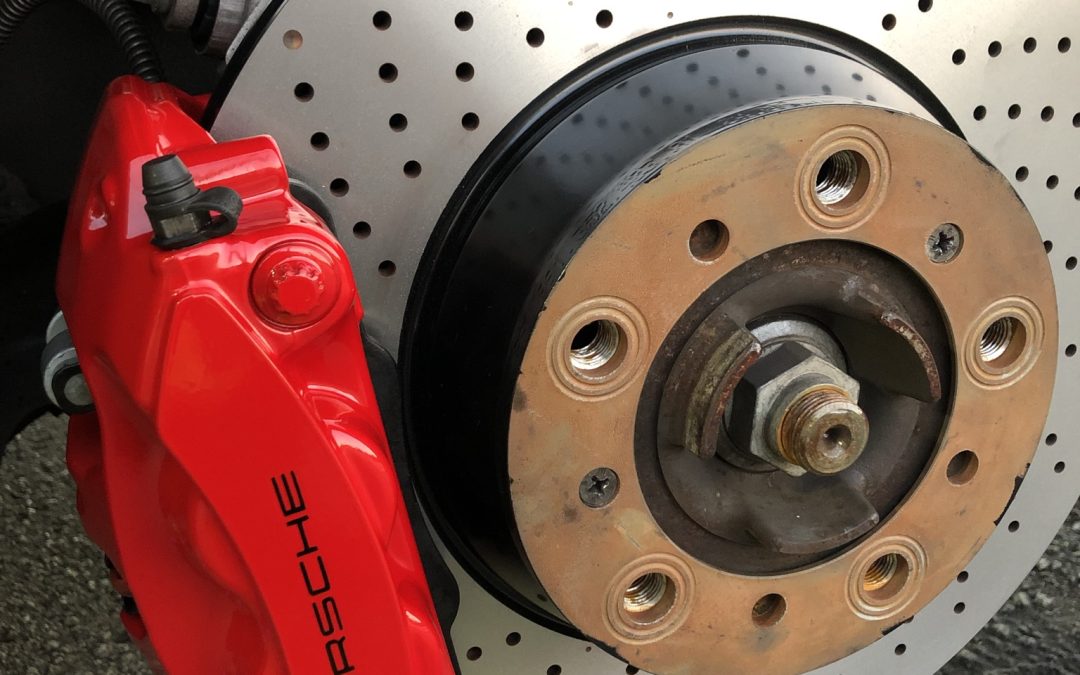
For Porsche Taycan owners, brake calipers are one of the few exterior components that remain highly visible through the wheels. A custom finish in red, yellow, orange, blue, purple, or green can change the car’s appearance without changing its performance, but many owners understandably ask whether refinishing affects regenerative braking or factory warranty coverage.
The short answer is that properly performed powder coating is a cosmetic finish change. It does not alter the Taycan’s regenerative braking programming, electric motors, brake sensors, hydraulic operation, or friction-braking strategy. Warranty questions are more specific and depend on the vehicle’s warranty documents and the cause of any future repair.
Does powder coating affect Taycan regenerative braking?
No. The color or texture applied to the outside of a brake caliper does not communicate with the Taycan’s electronic braking systems.
Regenerative braking uses the Taycan’s electric motors as generators. During deceleration, the motors convert some of the vehicle’s kinetic energy into electrical energy that returns to the high-voltage battery. Porsche explains that approximately 90% of everyday braking can be handled electrically, while the conventional hydraulic brakes are added when more stopping power is required.
Powder coating does not change:
- Regenerative braking software or calibration
- Electric motor operation
- Brake-by-wire controls
- ABS or stability-control sensors
- Brake pads or rotors
- Brake fluid or hydraulic lines
- Pistons, piston seals, or dust boots
- Electronic components connected to the brake system
The coating is applied to the caliper’s exterior casting and, when included, the appropriate brackets. The braking components that create hydraulic pressure, friction, and electronic control remain functionally unchanged.
Porsche describes this system in its technical explanation of Taycan energy recuperation, noting that the vehicle’s control systems decide within milliseconds how much braking comes from the electric motors and how much comes from the hydraulic brakes. A surface finish cannot change that decision-making process.
How regen changes the way Taycan brakes are used
A Taycan still has a complete friction-braking system, but it does not use the pads and rotors for every ordinary stop. Regenerative braking handles much of the deceleration during routine driving, such as slowing for traffic, approaching an intersection, or reducing speed on a typical Bay Area commute.
The friction brakes are more likely to be used in situations such as:
- Completing a stop at very low speeds
- Hard or emergency braking
- Driving when the battery is fully charged and cannot accept much additional energy
- Certain ABS, traction-control, or stability-control events
- High-load or repeated high-speed braking
This braking pattern creates a useful cosmetic benefit for a customized caliper finish. Since the friction brakes are used less often than they would be on a comparable gasoline-powered performance car, Taycan wheels typically experience less brake dust and less routine heat cycling.
That does not mean friction brakes can be ignored. Brake fluid, pads, rotors, caliper hardware, and the braking surfaces still require inspection according to Porsche’s maintenance guidance. It simply means the caliper finish is often exposed to a less aggressive day-to-day environment than on a vehicle that relies entirely on friction braking.
What makes professional caliper powder coating different?
A powder-coated caliper should not be treated like a part that can simply be sprayed with consumer paint. The quality of the result depends on preparation, masking, material selection, and curing.
A professional refinishing process generally includes the following steps:
1. Careful removal and disassembly
The calipers are removed from the vehicle or supplied as a separate core set. Components that should not receive coating are removed or protected. The finish is intended for the exterior caliper body and approved brackets, not for piston bores, seal lands, bleeder ports, hydraulic connections, or electronic parts.
2. Cleaning and media blasting
Old finishes, brake dust, grease, and corrosion are removed before coating. Media blasting creates a clean, profiled surface that allows the powder to bond properly. California Calipers describes this preparation in its guide to what powder coating is and how it is applied.
3. Precise masking
Machined mounting surfaces and threaded areas must remain clear. Masking is also important around bolt holes, piston openings, brake-line connections, and other areas where added coating thickness could interfere with assembly.
This is one of the most important differences between a professional job and a quick rattle-can application. A visually attractive finish is not enough if coating is left on a precision mating surface.
4. High-temperature powder and controlled curing
Powder coating is applied as a dry material and then cured in an oven. Many high-temperature automotive powders cure in the approximate range of 350–400°F at the metal temperature, although the correct schedule depends on the specific powder formulation and substrate.
The part must reach the required temperature for the required time. Proper curing produces a durable finish that resists normal environmental exposure, brake dust, and cleaning. California Calipers has more than 15 years of powder coating experience and offers a broad range of color options for automotive projects.
Can Porsche decals be added after powder coating?
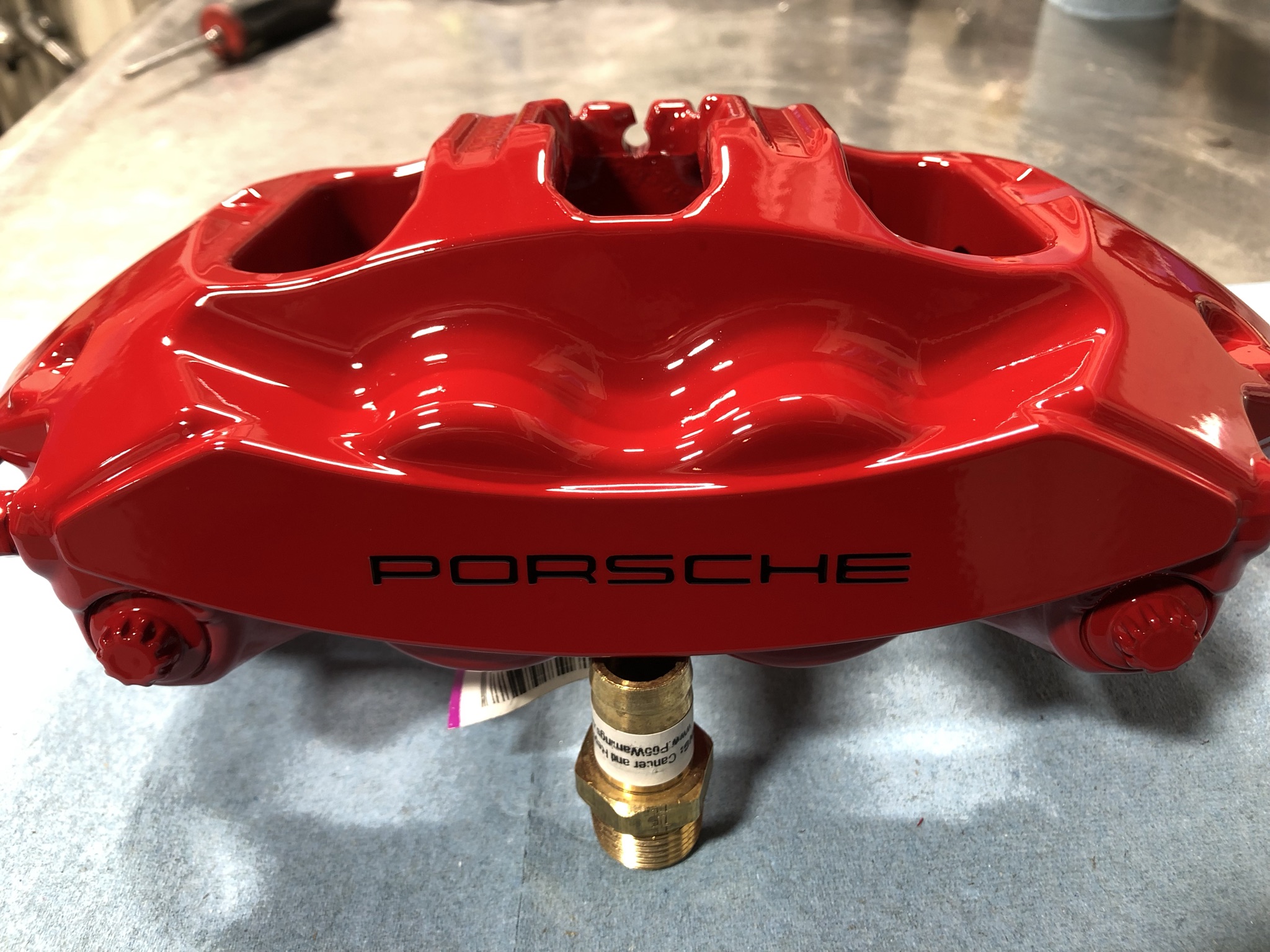
Yes. Porsche branding can be retained or recreated as part of the refinishing process, depending on the condition of the original lettering and the requested finish.
For decal work, California Calipers applies high-temperature decals and then applies a powder-coat clear over both the caliper and decal. This helps protect the lettering from fading or peeling while creating a consistent finished surface.
The result can be subtle, such as a gloss black caliper with contrasting Porsche lettering, or more distinctive, such as a purple, blue, orange, red, or green caliper with a bright logo. The appropriate color depends on the Taycan’s body color, wheel design, interior trim, and the owner’s preferred level of contrast.

Does powder coating void the Taycan warranty?
A properly applied cosmetic finish does not automatically void the entire Porsche vehicle warranty. It also does not change how the Taycan’s regenerative or friction-braking systems operate.
However, warranty coverage should be discussed carefully because warranty decisions depend on the specific vehicle, warranty year, policy wording, and cause of the claimed repair. Porsche’s U.S. warranty information lists a four-year or 50,000-mile new-vehicle warranty, and Porsche provides separate warranty manuals for different model years, including the 2026 Battery Electric Vehicle Warranty Manual.
A cosmetic finish change should not affect unrelated coverage for components such as the high-voltage battery, infotainment system, body panels, or electric motors. For brake-related claims, owners should understand the distinction between:
- A cosmetic finish issue
- Normal wear of pads and rotors
- A pre-existing mechanical defect
- Damage caused by improper disassembly, coating, or reassembly
California Calipers cannot determine how Porsche will evaluate a future warranty claim. Owners who are still within factory or Porsche Approved coverage should review the warranty documents for their specific vehicle and contact an authorized Porsche Center before authorizing refinishing if written confirmation is important to them.
The practical point is simple: professional powder coating is a cosmetic service, but no outside refinishing company should promise that a manufacturer will approve every future brake-related claim. Keeping documentation of the work, using a qualified installer, and confirming policy wording provides the clearest path.
Core exchange can reduce turnaround time
Taycan owners do not always need to leave their vehicle waiting while the original calipers are being refinished. With a core exchange, California Calipers can provide a compatible set from stock for the refinishing process.
The owner can choose to:
- Send in the vehicle’s existing calipers for refinishing, or
- Use a set already in stock for a faster turnaround
A core charge applies when a stock set is supplied. That charge is refunded when the owner’s original calipers are returned as the exchange cores, subject to the program’s terms.
This option can be useful for Bay Area owners in San Jose, San Francisco, the Peninsula, and surrounding communities who want a more efficient installation schedule.
A cosmetic upgrade that leaves braking behavior unchanged
For the Taycan, powder coating the calipers changes what is visible behind the wheels, not how the vehicle stops. Regenerative braking continues to be controlled by the electric motors and Porsche’s electronic brake-management systems. The hydraulic components continue to operate as designed, and the caliper finish has no role in deciding when the car uses regen or friction braking.
The most important factors are the quality of the refinishing process, accurate masking, proper curing, and careful reinstallation. A custom color can then add a distinctive detail to the Taycan while preserving the Porsche-branded character of the brake system.
For more examples, see California Calipers’ Porsche brake refinishing service content and Porsche caliper color ideas. The photo gallery also shows examples of finished automotive parts and calipers.
About California Calipers / Contact Us
California Calipers
831-435-9558
californiacalipers@nullgmail.com
https://www.californiacalipers.com/
Recent Comments