


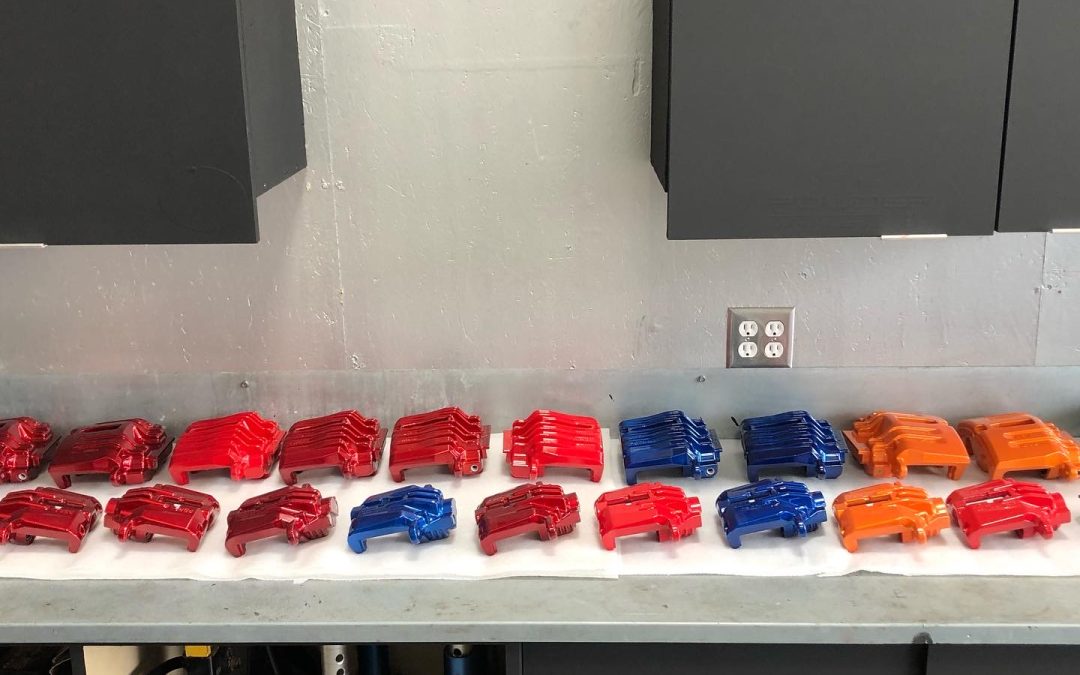
If you own a Mopar: whether it’s a tire-shredding Hellcat, a sleek Chrysler 300, or a classic Dodge Magnum: you know that the Mopar community is all about one thing: presence. From the rumble of the Hemi to the iconic high-impact colors that define the brand’s history, these cars are built to be noticed. But there is one glaring detail that often gets overlooked, and it’s usually hiding right behind those expensive alloy wheels: the brake calipers.
For years, the go-to solution for ugly, industrial-looking calipers was a Saturday afternoon and a $10 can of "caliper paint" from the local auto parts store. But times have changed. In the modern Mopar world, "close enough" is no longer acceptable. The trend has shifted decisively toward professional powder coating, and for good reason. Paint simply can’t keep up with the heat, the chemicals, or the aesthetic demands of a high-performance machine.
The Death of the Rattle Can: Why Paint Fails
Let’s be honest. We’ve all seen it: the "rattle-can special." It looks great for about twenty minutes, or at least until the first time the brakes get up to operating temperature. Traditional automotive paint, even the stuff labeled "high-heat," is a liquid solvent-based product. It’s thin, it’s brittle, and it’s prone to failure in the harsh environment of a wheel well.
Brake calipers are subjected to extreme thermal cycling. They go from ambient temperature to hundreds of degrees in a matter of seconds. This constant expansion and contraction causes traditional paint to crack. Once a microscopic crack forms, brake dust, road salt, and moisture get underneath the surface. Before long, that "custom" red finish is peeling off in flakes, leaving the car looking worse than when it had rusty factory iron.
Furthermore, brake fluid is one of the most aggressive solvents on the planet. If a single drop of fluid touches a painted caliper during a pad swap or a line bleed, the paint will bubble and lift almost instantly. For a Mopar enthusiast who takes pride in a clean build, this is a nightmare.
Why Powder Coating is the Superior Choice
So, why is everyone talking about powder coating? It comes down to the chemistry and the application process. Unlike paint, powder coating is a dry finishing process. Electrostatically charged particles of pulverized resin and pigment are sprayed onto the grounded metal caliper. The part is then placed in a specialized oven where the powder melts and chemically reacts to form a "skin."
This results in a finish that is significantly thicker and more durable than any liquid paint could ever dream of being. It’s not just a coating; it’s a protective shield.
- Heat Resistance: Powder coating is designed to handle the thermal stress of high-performance braking. It won’t crack or discolor when things get hot on a spirited canyon run.
- Chemical Resilience: Once cured, powder coating is remarkably resistant to brake fluid and harsh wheel cleaners.
- Uniformity: Because the powder is applied electrostatically, it wraps around corners and into crevices, providing a perfectly even finish that looks like it came straight from the factory: only better.
At California Calipers, with over 15 years of experience in the game, we’ve seen every DIY fail imaginable. We know that for a Charger or Challenger to look its best, the finish needs to be as tough as the engine under the hood.

The Mopar Palette: Precision Color Matching
One of the biggest reasons Mopar owners are flocking to custom calipers is the ability to match the legendary factory colors. Mopar has some of the most iconic paint codes in automotive history. Whether it’s the vintage vibe of Plum Crazy or the aggressive modern look of Destroyer Gray, "sort of red" or "basically blue" just doesn't cut it.
We specialize in precision Mopar factory color matching. Imagine your TorRed Challenger with calipers that are the exact same shade of fire-breathing red. Or a B5 Blue Charger with Brembos that pop against the metallic flake of the bodywork. We can even do custom decals to keep that Brembo or SRT branding looking sharp under the clear coat.

It’s about the details. When a car rolls into a show and the calipers perfectly complement the paint job, it signals that the owner didn't cut corners. It’s the difference between a "car project" and a "professional build."
The Core Exchange Program: Zero Downtime, All the Glory
The biggest hurdle for most enthusiasts is the downtime. Your Mopar is your pride and joy; you don't want it sitting on jack stands in the garage for two weeks while your calipers are shipped off, stripped, coated, and returned.
This is where California Calipers changes the game. Our Core Exchange Program is designed specifically for the busy Mopar owner, and it’s one of the ways the shop has streamlined this process over the last 15 years. Here’s how it works:
- Step 1: You order a set of freshly powder-coated calipers in your choice of color from our inventory.
- Step 2: we ship them to you, ready to install.
- Step 3: You (or your mechanic) swap the new calipers onto your car.
- Step 4: You put your old, "core" calipers in the box and ship them back to us.
That’s it. Your car is down for as long as it takes to do a standard brake job. No waiting, no jack stand blues, just instant gratification. We carry a massive inventory for the Chrysler 300, Dodge Charger, Challenger, and Magnum, ensuring that we usually have exactly what you need ready to go.
15 Years of Experience: Why Trust the Pros?
You might think, "Can't I just buy a powder coating kit and do it in my toaster oven?" Technically, you could try, but brake calipers are safety-critical components. This isn't just about making them look pretty; it’s about ensuring they function perfectly.
With 15 years of experience, California Calipers understands the nuances of brake refinishing. We don't just "spray and bake." Every set of calipers undergoes a rigorous process:
- Complete Teardown: Every seal, boot, and piston is removed. We never coat over rubber or moving parts.
- Media Blasting: We strip the factory finish down to raw metal to ensure maximum adhesion.
- Masking: This is the most critical step. We mask off every thread, piston bore, and mating surface with high-temp tape. If powder gets into the wrong place, your brakes won't work. Precision is everything.
- The Coating: Applied by pros who know exactly how much powder is "just right."
- Rebuild: We use fresh seals and hardware to ensure the calipers perform like new (or better).
When you choose professional powder coating over a DIY paint job, you aren't just paying for the color: you’re paying for the peace of mind that comes with expert craftsmanship.
Stopping Power with Style
The Mopar community is one of the most passionate in the world. Whether you’re part of a local Mopar club or you just like to turn heads at the stoplight, your car is a reflection of your personality. Leaving your calipers in their dull, factory state (or worse, with a flaking paint job) is like wearing a designer suit with dirty sneakers.
Custom calipers provide that "pop" that ties the whole vehicle together. They fill the void behind the wheel spokes and add a layer of sophistication that paint simply cannot achieve. From the heavy-duty stopping power of the 6-piston Brembos found on Scat Packs and Hellcats to the reliable single-piston setups on the 5.7L builds, every Mopar deserves to look as fast as it feels.
If you’re ready to ditch the rattle cans and upgrade to a finish that actually lasts, it’s time to see what professional powder coating can do for your ride. Browse our photo gallery to see some of the incredible Mopar transformations we’ve handled recently.
About California Calipers / Contact Us
California Calipers
831-435-9558
californiacalipers@nullgmail.com
https://www.californiacalipers.com/
Recent Comments